 |
NLMech
0.1.0
|
|
NLMech
0.1.0
|
An abstraction class to process geometry for damping force calculation. More...
#include <dampingGeom.h>
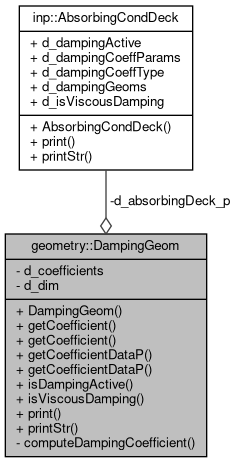
Public Member Functions | |
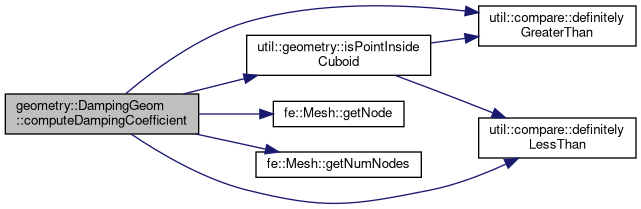
| DampingGeom (inp::AbsorbingCondDeck *deck, const fe::Mesh *mesh) | |
| Constructor. More... | |
| double | getCoefficient (const size_t &i) |
| Get nodal volume of node i. More... | |
| double | getCoefficient (const size_t &i) const |
| Get nodal volume of node i. More... | |
| const std::vector< double > * | getCoefficientDataP () |
| Get pointer to the coefficient data. More... | |
| const std::vector< double > * | getCoefficientDataP () const |
| Get pointer to the coefficient data. More... | |
| bool | isDampingActive () const |
| bool | isViscousDamping () const |
| void | print (int nt=0, int lvl=0) const |
| Prints the information about the instance of the object. More... | |
| std::string | printStr (int nt=0, int lvl=0) const |
| Returns the string containing information about the instance of the object. More... | |
Private Member Functions | |
| void | computeDampingCoefficient (const fe::Mesh *mesh) |
| Compute damping coefficients at nodal coordinates. More... | |
Private Attributes | |
| inp::AbsorbingCondDeck * | d_absorbingDeck_p |
| input deck for absorbing condition | |
| std::vector< double > | d_coefficients |
| Coefficients. | |
| size_t | d_dim |
| Dimension. | |
An abstraction class to process geometry for damping force calculation.
| geometry::DampingGeom::DampingGeom | ( | inp::AbsorbingCondDeck * | deck, |
| const fe::Mesh * | mesh | ||
| ) |
Constructor.
| deck | Input deck which contains user-specified information |
| mesh | Fe mesh object |
|
private |
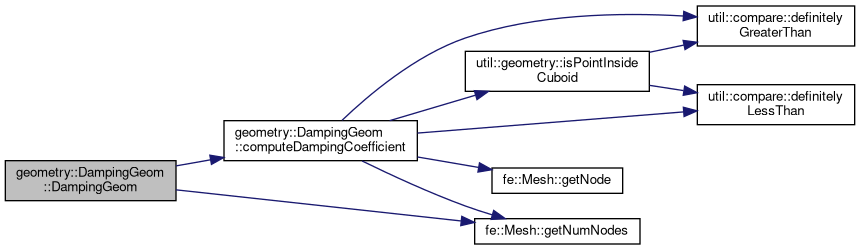
Compute damping coefficients at nodal coordinates.
| mesh | The mesh |
Referenced by DampingGeom().

| double geometry::DampingGeom::getCoefficient | ( | const size_t & | i | ) |
Get nodal volume of node i.
| i | Id of the node |
| double geometry::DampingGeom::getCoefficient | ( | const size_t & | i | ) | const |
Get nodal volume of node i.
| i | Id of the node |
| const std::vector< double > * geometry::DampingGeom::getCoefficientDataP | ( | ) |
Get pointer to the coefficient data.
| const std::vector< double > * geometry::DampingGeom::getCoefficientDataP | ( | ) | const |
Get pointer to the coefficient data.
| bool geometry::DampingGeom::isDampingActive | ( | ) | const |
Checks if damping is active
| bool geometry::DampingGeom::isViscousDamping | ( | ) | const |
Checks if viscous damping is active
|
inline |
Prints the information about the instance of the object.
| nt | Number of tabs to append before each line of string |
| lvl | Level of information sought (higher level means more information) |

| std::string geometry::DampingGeom::printStr | ( | int | nt = 0, |
| int | lvl = 0 |
||
| ) | const |
Returns the string containing information about the instance of the object.
| nt | Number of tabs to append before each line of string |
| lvl | Level of information sought (higher level means more information) |
Referenced by print().


 1.9.1
1.9.1