 |
NLMech
0.1.0
|
|
NLMech
0.1.0
|
A class for fracture state of bonds. More...
#include <fracture.h>
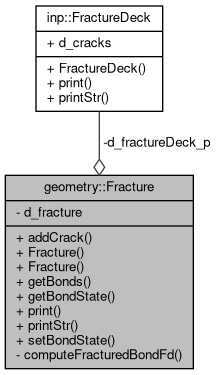
Public Member Functions | |
| bool | addCrack (const double &time, const std::vector< util::Point3 > *nodes, const std::vector< std::vector< size_t >> *neighbor_list) |
| Sets fracture state according to the crack data. More... | |
| Fracture (inp::FractureDeck *deck) | |
| Constructor. More... | |
| Fracture (inp::FractureDeck *deck, const std::vector< util::Point3 > *nodes, const std::vector< std::vector< size_t >> *neighbor_list) | |
| Constructor. More... | |
| std::vector< uint8_t > | getBonds (const size_t &i) const |
| Returns the list of bonds of node i. More... | |
| bool | getBondState (const size_t &i, const size_t &j) const |
| Read bond state. More... | |
| void | print (int nt=0, int lvl=0) const |
| Prints the information about the instance of the object. More... | |
| std::string | printStr (int nt=0, int lvl=0) const |
| Returns the string containing information about the instance of the object. More... | |
| void | setBondState (const size_t &i, const size_t &j, const bool &state) |
| Sets the bond state. More... | |
Private Member Functions | |
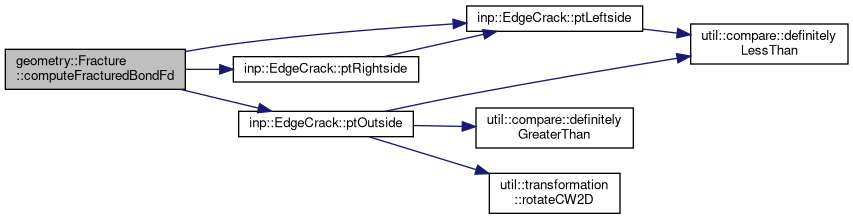
| void | computeFracturedBondFd (const size_t &i, inp::EdgeCrack *crack, const std::vector< util::Point3 > *nodes, const std::vector< size_t > *neighbors) |
| Sets state of bond which intersect the pre-crack line as fractured. More... | |
Private Attributes | |
| std::vector< std::vector< uint8_t > > | d_fracture |
| Vector which stores the state of bonds. More... | |
| inp::FractureDeck * | d_fractureDeck_p |
| Interior flags deck. | |
A class for fracture state of bonds.
This class provides method to read and modify fracture state of bonds
| geometry::Fracture::Fracture | ( | inp::FractureDeck * | deck, |
| const std::vector< util::Point3 > * | nodes, | ||
| const std::vector< std::vector< size_t >> * | neighbor_list | ||
| ) |
Constructor.
| deck | Input deck which contains user-specified information |
| nodes | Pointer to nodal coordinates |
| neighbor_list | Pointer to neighbor list |
|
explicit |
Constructor.
| deck | Input deck which contains user-specified information |
| bool geometry::Fracture::addCrack | ( | const double & | time, |
| const std::vector< util::Point3 > * | nodes, | ||
| const std::vector< std::vector< size_t >> * | neighbor_list | ||
| ) |
Sets fracture state according to the crack data.
| time | Actual simulation time |
| nodes | Pointer to nodal coordinates |
| neighbor_list | Pointer to neighbor list |

|
private |
Sets state of bond which intersect the pre-crack line as fractured.
| i | Nodal id |
| crack | Pointer to the pre-crack |
| nodes | Pointer to nodal coordinates |
| neighbors | Pointer to neighbors of node i |
| std::vector< uint8_t > geometry::Fracture::getBonds | ( | const size_t & | i | ) | const |
Returns the list of bonds of node i.
| i | Nodal id |
| bool geometry::Fracture::getBondState | ( | const size_t & | i, |
| const size_t & | j | ||
| ) | const |
Read bond state.
| i | Nodal id |
| j | Local id of bond in neighbor list of i |
Referenced by test::testFracture().

|
inline |
Prints the information about the instance of the object.
| nt | Number of tabs to append before each line of string |
| lvl | Level of information sought (higher level means more information) |

| std::string geometry::Fracture::printStr | ( | int | nt = 0, |
| int | lvl = 0 |
||
| ) | const |
Returns the string containing information about the instance of the object.
| nt | Number of tabs to append before each line of string |
| lvl | Level of information sought (higher level means more information) |
Referenced by print().


| void geometry::Fracture::setBondState | ( | const size_t & | i, |
| const size_t & | j, | ||
| const bool & | state | ||
| ) |
Sets the bond state.
| i | Nodal id |
| j | Local id of bond in neighbor list of i |
| state | State which is applied to the bond |
Referenced by test::testFracture().

|
private |
Vector which stores the state of bonds.
Given node i, vector d_fracture[i] is the list of state of bonds of node i.
We only use 1 bit per bond of node to store the state.
Referenced by Fracture().
 1.9.1
1.9.1