 |
NLMech
0.1.0
|
|
NLMech
0.1.0
|
Provides geometrical methods such as point inside rectangle. More...
Functions | |
| double | derLinearStepFunc (const double &x, const double &x1, const double &x2) |
| Compute derivative of linear step function. More... | |
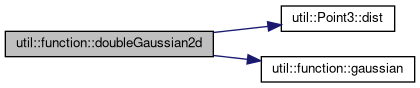
| double | doubleGaussian2d (const util::Point3 &x, const size_t &dof, const std::vector< double > ¶ms) |
| Compute sum of two Gaussian function in 2-d. More... | |
| double | gaussian (const double &r, const double &a, const double &beta) |
| Compute Gaussian function in 1-d. More... | |
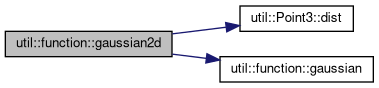
| double | gaussian2d (const util::Point3 &x, const size_t &dof, const std::vector< double > ¶ms) |
| Compute Gaussian function in 2-d. More... | |
| double | getDeterminant (const std::vector< util::Point3 > &rows) |
| Get determinant of 3-d matrix. More... | |
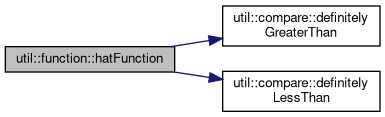
| double | hatFunction (const double &x, const double &x_min, const double &x_max) |
| Computes hat function at given point. More... | |
| double | hatFunctionQuick (const double &x, const double &x_min, const double &x_max) |
| Computes hat function at given point. More... | |
| double | linearStepFunc (const double &x, const double &x1, const double &x2) |
| Compute linear step function. More... | |
| util::Point3 | signVector (const util::Point3 &v) |
| Get vector with plus or minus 1 depending on the sign of component of another vector. More... | |
Provides geometrical methods such as point inside rectangle.
| double util::function::derLinearStepFunc | ( | const double & | x, |
| const double & | x1, | ||
| const double & | x2 | ||
| ) |
Compute derivative of linear step function.
| x | Point in real line |
| x1 | Point such that function is linear with slope 1 in [0, x1) |
| x2 | Point such that function is constant in [x1, x1 + x2) |
Referenced by loading::ULoading::apply().


| double util::function::doubleGaussian2d | ( | const util::Point3 & | x, |
| const size_t & | dof, | ||
| const std::vector< double > & | params | ||
| ) |
Compute sum of two Gaussian function in 2-d.
Double Gaussian (2-d) function:
![\[ f(x,y) = (f_1(x,y), f_2(x,y)) + (g_1(x,y), g_2(x,y)), \]](form_269.png)
where  and
and  are two Gaussian 2-d function as described in Gaussian2d() with different values of
  .
.
| x | Coordinates of point |
| params | List of parameters |
| dof | Component of Gaussian function |
Referenced by loading::InitialCondition::getICFormula().

| double util::function::gaussian | ( | const double & | r, |
| const double & | a, | ||
| const double & | beta | ||
| ) |
Compute Gaussian function in 1-d.
Gaussian (1-d) function: 
Here  is the amplitude and
  is the exponential factor.
| r | Distance from origin |
| a | Amplitude |
| beta | Factor in exponential function |
Referenced by doubleGaussian2d(), and gaussian2d().

| double util::function::gaussian2d | ( | const util::Point3 & | x, |
| const size_t & | dof, | ||
| const std::vector< double > & | params | ||
| ) |
Compute Gaussian function in 2-d.
Gaussian (2-d) function:
![\[ f(x,y) = (f_1(x,y), f_2(x,y)), \]](form_265.png)
where
![\[ f_1(x,y) = a \exp(-\frac{(x-x_c)^2 + (y-y_c)^2}{\beta}) d_1, \quad f_1(x,y) = a \exp(-\frac{(x-x_c)^2 + (y-y_c)^2}{\beta}) d_2. \]](form_266.png)
Here  is the center of the pulse, is the amplitude, is the exponential factor, and
  is the direction of the pulse.
| x | Coordinates of point |
| params | List of parameters |
| dof | Component of Gaussian function |
Referenced by loading::InitialCondition::getICFormula().

| double util::function::getDeterminant | ( | const std::vector< util::Point3 > & | rows | ) |
Get determinant of 3-d matrix.
| rows | Three rows of matrix |
Referenced by util::geometry::getTetVolume().

| double util::function::hatFunction | ( | const double & | x, |
| const double & | x_min, | ||
| const double & | x_max | ||
| ) |
Computes hat function at given point.
Hat function: f ^ | | 1 o | /|\ | / | \ | / | \ | / | \ | / | \ | / | \ o____________o____________o______\ x / x_min x_max
| x | Point in real line |
| x_min | Left side point in real line |
| x_max | Right side point in real line |
Referenced by loading::FLoading::apply().

| double util::function::hatFunctionQuick | ( | const double & | x, |
| const double & | x_min, | ||
| const double & | x_max | ||
| ) |
Computes hat function at given point.
This version does not test if point x is in valid interval.
Hat function: f ^ | | 1 o | /|\ | / | \ | / | \ | / | \ | / | \ | / | \ o____________o____________o______\ x / x_min x_max
| x | Point in real line |
| x_min | Left side point in real line |
| x_max | Right side point in real line |

| double util::function::linearStepFunc | ( | const double & | x, |
| const double & | x1, | ||
| const double & | x2 | ||
| ) |
Compute linear step function.
Step function:
f ^ | __________ | / | / | _______/ | / | / |/_________________________ t x1 x1+x2
| x | Point in real line |
| x1 | Point such that function is linear with slope 1 in [0, x1) |
| x2 | Point such that function is constant in [x1, x1 + x2) |
Referenced by loading::FLoading::apply(), and loading::ULoading::apply().


| util::Point3 util::function::signVector | ( | const util::Point3 & | v | ) |
Get vector with plus or minus 1 depending on the sign of component of another vector.
| v | Vector from which a new vector is created |

 1.9.1
1.9.1