 |
NLMech
0.1.0
|
|
NLMech
0.1.0
|
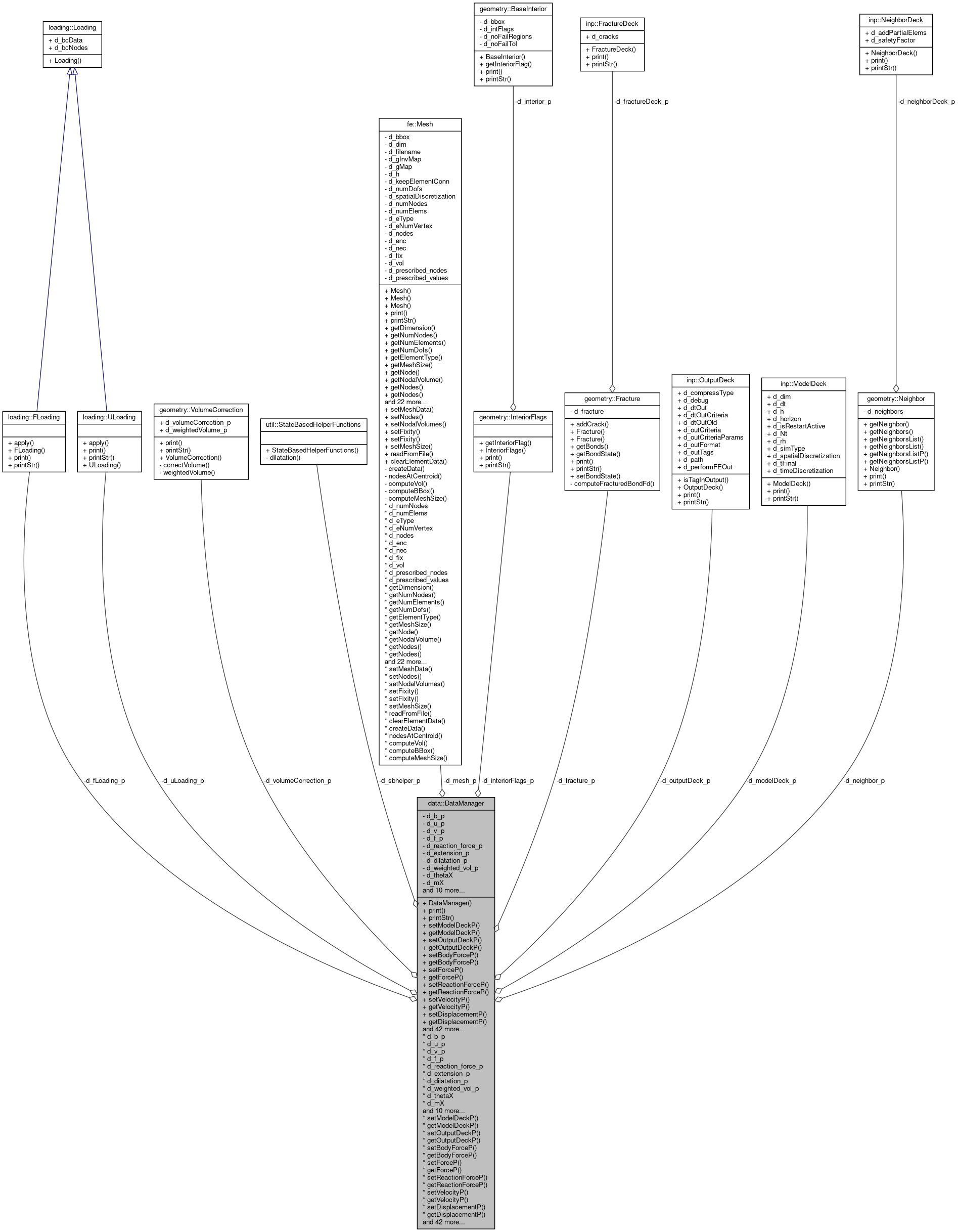
Data manager to collect the global simulation data. More...
#include <DataManager.h>
Public Member Functions | |
| DataManager () | |
| Constructor. | |
| void | print (int nt=0, int lvl=0) const |
| Prints the information about the instance of the object. More... | |
| std::string | printStr (int nt=0, int lvl=0) const |
| Returns the string containing information about the instance of the object. More... | |
Access to the deck objects | |
| void | setModelDeckP (inp::ModelDeck *pointer) |
| inp::ModelDeck * | getModelDeckP () |
| void | setOutputDeckP (inp::OutputDeck *pointer) |
| inp::OutputDeck * | getOutputDeckP () |
Access methods | |
| void | setBodyForceP (std::vector< util::Point3 > *pointer) |
| std::vector< util::Point3 > * | getBodyForceP () |
| void | setForceP (std::vector< util::Point3 > *pointer) |
| std::vector< util::Point3 > * | getForceP () |
| void | setReactionForceP (std::vector< util::Point3 > *pointer) |
| std::vector< util::Point3 > * | getReactionForceP () |
| void | setVelocityP (std::vector< util::Point3 > *pointer) |
| std::vector< util::Point3 > * | getVelocityP () |
| void | setDisplacementP (std::vector< util::Point3 > *pointer) |
| std::vector< util::Point3 > * | getDisplacementP () |
| void | setMeshP (fe::Mesh *d_mesh_p) |
| fe::Mesh * | getMeshP () |
| void | setNeighborP (geometry::Neighbor *d_neighbor_p) |
| geometry::Neighbor * | getNeighborP () |
| void | setVolumeCorrectionP (geometry::VolumeCorrection *pointer) |
| geometry::VolumeCorrection * | getVolumeCorrectionP () |
| void | setFractureP (geometry::Fracture *pointer) |
| geometry::InteriorFlags * | getInteriorFlagsP () |
| void | setInteriorFlagsP (geometry::InteriorFlags *pointer) |
| geometry::Fracture * | getFractureP () |
| void | setStateBasedHelperFunctionsP (util::StateBasedHelperFunctions *pointer) |
| util::StateBasedHelperFunctions * | getStateBasedHelperFunctionsP () |
| void | setDisplacementLoadingP (loading::ULoading *pointer) |
| loading::ULoading * | getDisplacementLoadingP () |
| void | setForceLoadingP (loading::FLoading *pointer) |
| loading::FLoading * | getForceLoadingP () |
| void | setExtensionP (std::vector< std::vector< double >> *pointer) |
| std::vector< std::vector< double > > * | getExtensionP () |
| void | setStressTensorP (std::vector< util::Matrix33 > *pointer) |
| std::vector< util::Matrix33 > * | getStressTensorP () |
| void | setStrainTensorP (std::vector< util::Matrix33 > *pointer) |
| std::vector< util::Matrix33 > * | getStrainTensorP () |
| void | setDilatationP (std::vector< double > *pointer) |
| std::vector< double > * | getDilatationP () |
| void | setWeightedVolP (std::vector< double > *pointer) |
| std::vector< double > * | getWeightedVolP () |
| void | setTotalReactionForceP (std::vector< double > *pointer) |
| std::vector< double > * | getTotalReactionForceP () |
| void | setStrainEnergyP (std::vector< float > *pointer) |
| std::vector< float > * | getStrainEnergyP () |
| void | setWorkDoneP (std::vector< float > *pointer) |
| std::vector< float > * | getWorkDoneP () |
| void | setPhiP (std::vector< float > *pointer) |
| std::vector< float > * | getPhiP () |
| void | setDamageFunctionP (std::vector< float > *pointer) |
| std::vector< float > * | getDamageFunctionP () |
| void | setBBFractureEnergyP (std::vector< float > *pointer) |
| std::vector< float > * | getBBFractureEnergyP () |
| void | setFractureEnergyP (std::vector< float > *pointer) |
| std::vector< float > * | getFractureEnergyP () |
| void | setKineticEnergyP (std::vector< float > *pointer) |
| std::vector< float > * | getKineticEnergyP () |
Private Attributes | |
Pointers to the deck objects | |
| inp::ModelDeck * | d_modelDeck_p = nullptr |
| Model deck. | |
| inp::OutputDeck * | d_outputDeck_p = nullptr |
| Output deck. | |
Pointers to the major simulation data | |
| std::vector< util::Point3 > * | d_b_p = nullptr |
| Pointer to the body force vector. | |
| std::vector< util::Point3 > * | d_u_p = nullptr |
| Pointer to the displacement vector. | |
| std::vector< util::Point3 > * | d_v_p = nullptr |
| Pointer to the velocity vector. | |
| std::vector< util::Point3 > * | d_f_p = nullptr |
| Pointer to the force vector. | |
| std::vector< util::Point3 > * | d_reaction_force_p = nullptr |
| Pointer to the reaction force. | |
| std::vector< std::vector< double > > * | d_extension_p = nullptr |
| Extension for the neighborhood of each node. | |
| std::vector< double > * | d_dilatation_p = nullptr |
| Dilatation of nodes. | |
| std::vector< double > * | d_weighted_vol_p = nullptr |
| Weighted volume. | |
| std::vector< double > | d_thetaX |
| Dilation. More... | |
| std::vector< double > | d_mX |
| Weighted volume. More... | |
| std::vector< float > * | d_e_p = nullptr |
| Pointer to the strain energy vector. | |
| std::vector< double > * | d_total_reaction_force_p = nullptr |
| Pointer to the total reaction force vector. | |
| std::vector< float > * | d_w_p = nullptr |
| Pointer to the Work done on each of the nodes. | |
| std::vector< float > * | d_phi_p = nullptr |
Pointer to damage function  at the nodes. at the nodes. | |
| std::vector< float > * | d_Z_p = nullptr |
Pointer to damage function  at the nodes. at the nodes. | |
| std::vector< float > * | d_eFB_p = nullptr |
| Pointer to bond-based fracture energy of the nodes. | |
| std::vector< float > * | d_eF_p = nullptr |
| Pointer to fracture energy of the nodes. | |
| std::vector< float > * | d_ke_p = nullptr |
| Pointer to the kinetic energy of the nodes. | |
| std::vector< util::Matrix33 > * | d_strain_p = nullptr |
| Pointer to the strain tensor vector. | |
| std::vector< util::Matrix33 > * | d_stress_p = nullptr |
| Pointer to the stress tensor vector. | |
| fe::Mesh * | d_mesh_p = nullptr |
| Pointer to Mesh object. | |
| geometry::Neighbor * | d_neighbor_p = nullptr |
| Pointer to Neighbor object. | |
| geometry::VolumeCorrection * | d_volumeCorrection_p = nullptr |
| Pointer to Volume Correction object. | |
| geometry::Fracture * | d_fracture_p = nullptr |
| Pointer to Fracture object. | |
| geometry::InteriorFlags * | d_interiorFlags_p = nullptr |
| Pointer to InteriorFlags object. | |
| util::StateBasedHelperFunctions * | d_sbhelper_p = nullptr |
| Pointer to StatebasedHelper function object. | |
| loading::ULoading * | d_uLoading_p = nullptr |
| Pointer to displacement Loading object. | |
| loading::FLoading * | d_fLoading_p = nullptr |
| Pointer to force Loading object. | |
Data manager to collect the global simulation data.
| std::vector< float > * data::DataManager::getBBFractureEnergyP | ( | ) |
Get the pointer to bond-based fracture energy
Referenced by model::Output::Output().

| std::vector< util::Point3 > * data::DataManager::getBodyForceP | ( | ) |
Get the pointer to the body force
| std::vector< float > * data::DataManager::getDamageFunctionP | ( | ) |
Get the pointer to damage function
Referenced by model::Output::Output().

| std::vector< double > * data::DataManager::getDilatationP | ( | ) |
Get the pointer to dilatation
Referenced by util::StateBasedHelperFunctions::dilatation().

| loading::ULoading * data::DataManager::getDisplacementLoadingP | ( | ) |
Get the pointer to displacement loading object
| std::vector< util::Point3 > * data::DataManager::getDisplacementP | ( | ) |
Get the pointer to displacement
Referenced by model::Output::Output().

| std::vector< std::vector< double > > * data::DataManager::getExtensionP | ( | ) |
Get the pointer to extension state
Referenced by util::StateBasedHelperFunctions::StateBasedHelperFunctions().

| loading::FLoading * data::DataManager::getForceLoadingP | ( | ) |
Get the pointer to force loading object
| std::vector< util::Point3 > * data::DataManager::getForceP | ( | ) |
Get the pointer to force
Referenced by model::Output::Output().

| std::vector< float > * data::DataManager::getFractureEnergyP | ( | ) |
Get the pointer to fracture energy
Referenced by model::Output::Output().

| geometry::Fracture * data::DataManager::getFractureP | ( | ) |
Get the pointer to the mesh object
| geometry::InteriorFlags * data::DataManager::getInteriorFlagsP | ( | ) |
Get the pointer to volume correction
| std::vector< float > * data::DataManager::getKineticEnergyP | ( | ) |
Get the pointer to kinetic energy
Referenced by model::Output::Output().

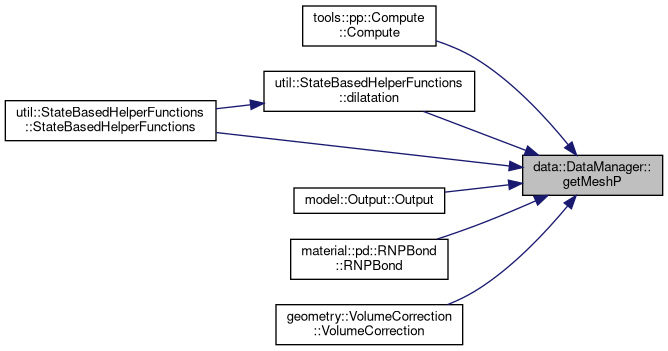
| fe::Mesh * data::DataManager::getMeshP | ( | ) |
Get the pointer to the mesh object
Referenced by tools::pp::Compute::Compute(), util::StateBasedHelperFunctions::dilatation(), model::Output::Output(), material::pd::RNPBond::RNPBond(), util::StateBasedHelperFunctions::StateBasedHelperFunctions(), and geometry::VolumeCorrection::VolumeCorrection().
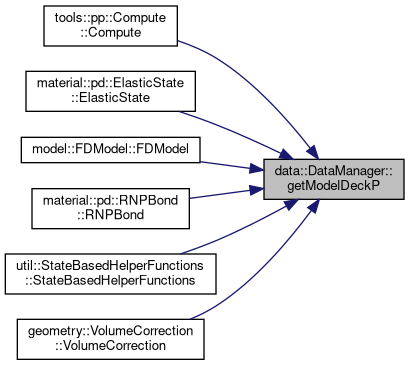
| inp::ModelDeck * data::DataManager::getModelDeckP | ( | ) |
Get the pointer to the model deck
Referenced by tools::pp::Compute::Compute(), material::pd::ElasticState::ElasticState(), model::FDModel< T >::FDModel(), material::pd::RNPBond::RNPBond(), util::StateBasedHelperFunctions::StateBasedHelperFunctions(), and geometry::VolumeCorrection::VolumeCorrection().
| geometry::Neighbor * data::DataManager::getNeighborP | ( | ) |
Get the pointer to neighborhood object
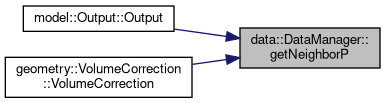
Referenced by model::Output::Output(), and geometry::VolumeCorrection::VolumeCorrection().
| inp::OutputDeck * data::DataManager::getOutputDeckP | ( | ) |
Get the pointer to the output deck
Referenced by material::pd::ElasticState::ElasticState().

| std::vector< float > * data::DataManager::getPhiP | ( | ) |
Get the pointer to phi
Referenced by model::Output::Output().

| std::vector< util::Point3 > * data::DataManager::getReactionForceP | ( | ) |
Get the pointer to reaction force
Referenced by model::Output::Output().

| util::StateBasedHelperFunctions * data::DataManager::getStateBasedHelperFunctionsP | ( | ) |
Get the pointer to state-nased helper functions
Referenced by material::pd::ElasticState::ElasticState().

| std::vector< float > * data::DataManager::getStrainEnergyP | ( | ) |
Get the pointer to strain energy
Referenced by model::Output::Output().

| std::vector< util::Matrix33 > * data::DataManager::getStrainTensorP | ( | ) |
Get the pointer to strain tensor
Referenced by model::Output::Output().

| std::vector< util::Matrix33 > * data::DataManager::getStressTensorP | ( | ) |
Get the pointer to stress tensor
Referenced by model::Output::Output().

| std::vector< double > * data::DataManager::getTotalReactionForceP | ( | ) |
Get the pointer to total reaction force
Referenced by model::Output::Output().

| std::vector< util::Point3 > * data::DataManager::getVelocityP | ( | ) |
Get the pointer to velocity
Referenced by model::Output::Output().

| geometry::VolumeCorrection * data::DataManager::getVolumeCorrectionP | ( | ) |
Get the pointer to volume correction
| std::vector< double > * data::DataManager::getWeightedVolP | ( | ) |
Get the pointer to weighted volume data
| std::vector< float > * data::DataManager::getWorkDoneP | ( | ) |
Get the pointer to work done
Referenced by model::Output::Output().

|
inline |
Prints the information about the instance of the object.
| nt | Number of tabs to append before each line of string |
| lvl | Level of information sought (higher level means more information) |

| std::string data::DataManager::printStr | ( | int | nt = 0, |
| int | lvl = 0 |
||
| ) | const |
Returns the string containing information about the instance of the object.
| nt | Number of tabs to append before each line of string |
| lvl | Level of information sought (higher level means more information) |
Referenced by print().


| void data::DataManager::setBBFractureEnergyP | ( | std::vector< float > * | pointer | ) |
Sets the pointer to the bond-based fracture energy
| pointer | Pointer |
| void data::DataManager::setBodyForceP | ( | std::vector< util::Point3 > * | pointer | ) |
Sets the body force pointer
| pointer | Pointer |
| void data::DataManager::setDamageFunctionP | ( | std::vector< float > * | pointer | ) |
Sets the pointer to damage function
| pointer | Pointer |
| void data::DataManager::setDilatationP | ( | std::vector< double > * | pointer | ) |
Sets the pointer to the dilatation state
| pointer | Pointer |
Referenced by util::StateBasedHelperFunctions::dilatation().

| void data::DataManager::setDisplacementLoadingP | ( | loading::ULoading * | pointer | ) |
Sets the pointer to the displacement loading object
| pointer | Pointer |
| void data::DataManager::setDisplacementP | ( | std::vector< util::Point3 > * | pointer | ) |
Sets the displacement pointer
| pointer | Pointer |
| void data::DataManager::setExtensionP | ( | std::vector< std::vector< double >> * | pointer | ) |
Sets the pointer to the extension state
| pointer | Pointer |
Referenced by util::StateBasedHelperFunctions::StateBasedHelperFunctions().

| void data::DataManager::setForceLoadingP | ( | loading::FLoading * | pointer | ) |
Sets the pointer to the force loading object
| pointer | Pointer |
| void data::DataManager::setForceP | ( | std::vector< util::Point3 > * | pointer | ) |
Sets the force pointer
| pointer | Pointer |
| void data::DataManager::setFractureEnergyP | ( | std::vector< float > * | pointer | ) |
Sets the pointer to the fracture energy
| pointer | Pointer |
| void data::DataManager::setFractureP | ( | geometry::Fracture * | pointer | ) |
Sets the mesh pointer
| d_mesh_p | Pointer to the mesh object |
| void data::DataManager::setInteriorFlagsP | ( | geometry::InteriorFlags * | pointer | ) |
Sets the mesh pointer
| d_mesh_p | Pointer to the mesh object |
| void data::DataManager::setKineticEnergyP | ( | std::vector< float > * | pointer | ) |
Sets the pointer to the kinetic energy
| pointer | Pointer |
| void data::DataManager::setMeshP | ( | fe::Mesh * | d_mesh_p | ) |
Sets the mesh pointer
| d_mesh_p | Pointer to the mesh object |
| void data::DataManager::setModelDeckP | ( | inp::ModelDeck * | pointer | ) |
Sets the model deck pointer
| pointer | Pointer |
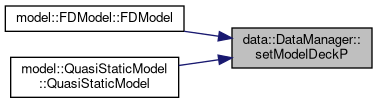
Referenced by model::FDModel< T >::FDModel(), and model::QuasiStaticModel< T >::QuasiStaticModel().
| void data::DataManager::setNeighborP | ( | geometry::Neighbor * | d_neighbor_p | ) |
Sets the neighborhood pointer
| d_neighbor_p | Pointer to the neighborhood object |
Referenced by tools::pp::Compute::Compute().

| void data::DataManager::setOutputDeckP | ( | inp::OutputDeck * | pointer | ) |
Sets the output deck pointer
| pointer | Pointer |
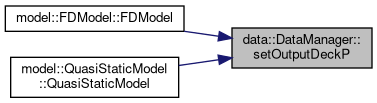
Referenced by model::FDModel< T >::FDModel(), and model::QuasiStaticModel< T >::QuasiStaticModel().
| void data::DataManager::setPhiP | ( | std::vector< float > * | pointer | ) |
Sets the pointer to the phi vector
| pointer | Pointer |
| void data::DataManager::setReactionForceP | ( | std::vector< util::Point3 > * | pointer | ) |
Sets the body reaction force pointer
| pointer | Pointer |
| void data::DataManager::setStateBasedHelperFunctionsP | ( | util::StateBasedHelperFunctions * | pointer | ) |
Sets the pointer to the state-based helper
| pointer | Pointer |
Referenced by material::pd::ElasticState::ElasticState().

| void data::DataManager::setStrainEnergyP | ( | std::vector< float > * | pointer | ) |
Sets the pointer to the strain energy
| pointer | Pointer |
| void data::DataManager::setStrainTensorP | ( | std::vector< util::Matrix33 > * | pointer | ) |
Sets the pointer to the strain tensor
| pointer | Pointer |
| void data::DataManager::setStressTensorP | ( | std::vector< util::Matrix33 > * | pointer | ) |
Sets the pointer to the stress tensor
| pointer | Pointer |
| void data::DataManager::setTotalReactionForceP | ( | std::vector< double > * | pointer | ) |
Sets the pointer to the total reaction force
| pointer | Pointer |
| void data::DataManager::setVelocityP | ( | std::vector< util::Point3 > * | pointer | ) |
Sets the velocity pointer
| pointer | Pointer |
| void data::DataManager::setVolumeCorrectionP | ( | geometry::VolumeCorrection * | pointer | ) |
Sets the volume correction pointer
| pointer | Pointer |
| void data::DataManager::setWeightedVolP | ( | std::vector< double > * | pointer | ) |
Sets the pointer to the weighted volume data
| pointer | Pointer |
| void data::DataManager::setWorkDoneP | ( | std::vector< float > * | pointer | ) |
Sets the pointer to the work done vector
| pointer | Pointer |
|
private |
Weighted volume.
In case of Regularized state based model, this data is not required
|
private |
Dilation.
In case of Regularized state based model, this will give the spherical (hydrostatic) strain
 1.9.1
1.9.1